Artificial intelligence (AI) has changed how brands plan, create, and measure advertising campaigns. Marketers no longer rely only on gut instinct or static audience lists. Marketers now use machine learning, natural language processing, and predictive models to find the right audience, generate creative faster, and spend advertising budgets more efficiently.
This guide explains what artificial intelligence advertising actually means, how businesses can use artificial intelligence inside a campaign, what challenges come with adoption, and what results businesses can realistically expect from artificial intelligence-powered advertising.
What Does Artificial Intelligence Mean for Advertising Campaigns Today?
AI advertising uses machine learning, natural language processing, and predictive analytics to automate and improve how campaigns are planned, targeted, created, and measured. AI analyzes large volumes of real-time and historical data to identify patterns that would take human teams far longer to uncover manually.
Instead of guessing which audience segment will respond to a message, AI evaluates behavioral signals, contextual signals, and campaign performance data together. This approach helps marketing teams deliver advertising that feels timely and relevant, at a scale that manual planning cannot match.
How Do Marketers Actually Use Artificial Intelligence Inside a Campaign?
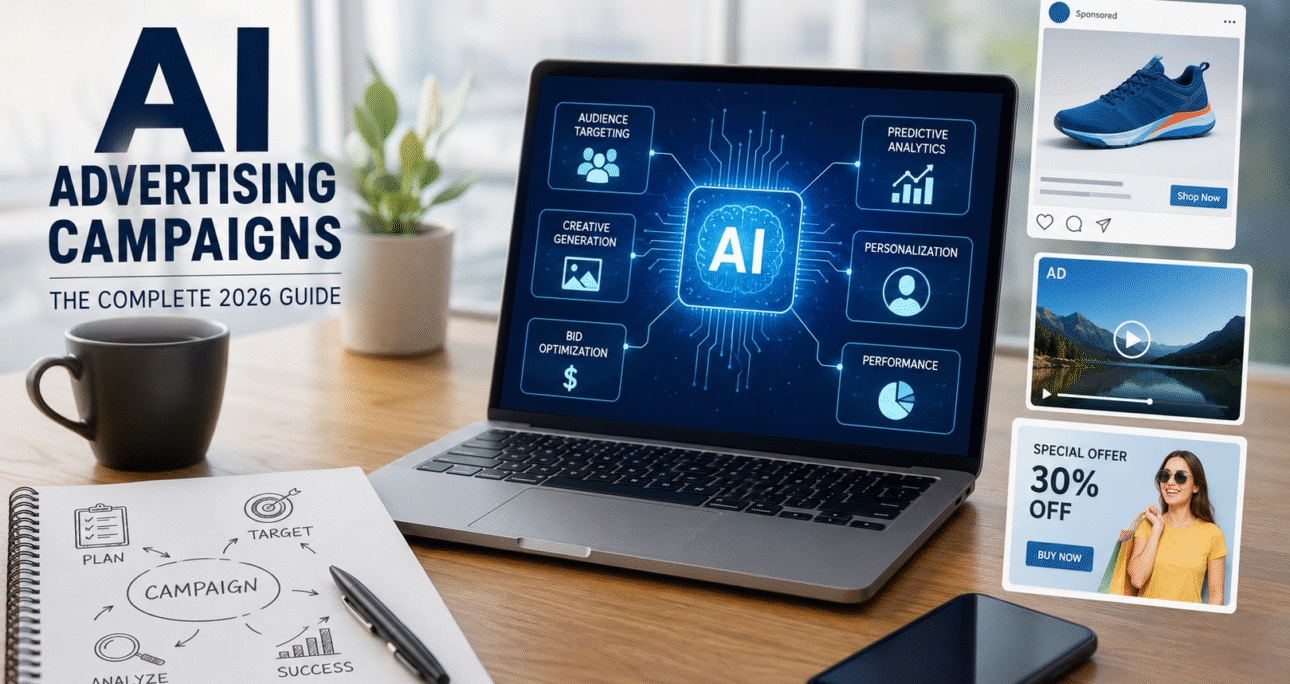
Marketing teams apply artificial intelligence across several distinct functions within a single campaign:
- Audience targeting: Machine learning models analyze behavioral and contextual signals to identify high-value audiences.
- Contextual targeting: Natural language processing reads the meaning and sentiment of a webpage to place ads in relevant, brand safe environments.
- Creative generation: Generative tools produce ad copy, images, and video concepts that a creative team can test and refine.
- Bid and budget optimization: Predictive models adjust bids and pacing in real time based on live performance signals.
- Measurement and forecasting: Predictive analytics identifies patterns from past campaigns to forecast likely outcomes for future campaigns.
- Fraud and brand safety detection: Machine learning flags suspicious traffic patterns and unsafe placements before those placements damage a brand.
- Workflow automation: AI reduces repetitive marketing tasks such as campaign reporting, performance monitoring, asset organization, and cross-channel workflows. This allows marketing teams to spend more time on strategy, testing, and creative decision-making.
- Cross-channel orchestration: AI helps coordinate campaigns across search, social media, display, video, email, and other digital channels to deliver a more consistent customer experience.
What Benefits Does Artificial Intelligence Bring to an Advertising Campaign?
More Accurate Targeting Without Depending on Third-Party Cookies
Privacy regulations and the decline of third-party cookies have pushed marketers toward contextual and first-party data strategies. Artificial intelligence reads page-level content, themes, and audience behavior together, allowing brands to reach relevant audiences without depending on invasive tracking methods. As third-party cookies continue to disappear, many businesses are combining AI with first-party customer data to build more accurate audience segments while respecting user privacy.
Faster Creative Production Across Formats
Producing ad copy, images, and video for multiple channels used to take a creative team days or weeks. Generative artificial intelligence tools now produce dozens of headline variations, image concepts, and video cuts within minutes, giving creative teams more raw material to test and refine.
According to Deloitte Digital’s research on generative artificial intelligence in marketing content production, twenty six percent of marketers already use generative artificial intelligence for content creation, and generative artificial intelligence users report saving an average of eleven point four hours per week that teams can redirect toward strategy and refinement.
Smarter Budget Allocation Through Predictive Analytics
Predictive models evaluate historical and live signals to forecast which placements, audiences, and creative variations will likely perform best. This shifts budget decisions from a reactive process, made after a campaign underperforms, to a proactive process that directs spend toward the opportunities most likely to convert.
Stronger Personalization at Scale
Consumers now expect brands to understand their preferences. According to research by Nidhi Arora and colleagues published by McKinsey & Company, seventy one percent of consumers expect companies to deliver personalized interactions, and seventy six percent report frustration when brands fail to meet that expectation. AI helps marketing teams meet that expectation by adjusting messaging, imagery, and offers based on what actually motivates each audience segment, rather than treating every customer the same way.
Better Fraud Prevention and Brand Safety
As advertising spend moves across more channels and platforms, the risk of ad fraud and brand unsafe placements grows. AI continuously scans traffic patterns, page content, and placement context to flag invalid clicks and unsafe environments before they waste media budget or damage brand reputation.
Clearer Measurement and Return on Investment Tracking
AI connects performance data across channels, giving marketing teams a clearer view of which touchpoints actually influence conversions. This visibility helps teams justify marketing spend and refine strategy with confidence, rather than relying on incomplete or delayed reporting.
How Can Businesses Use Artificial Intelligence to Generate Ad Creative at Scale?
Generative artificial intelligence tools can produce ad copy, static images, and short form video concepts from a simple text prompt. Marketing teams typically use these tools to generate a large volume of creative variations quickly, then apply human judgment to select, refine, and finalize the strongest options before launch.
Dynamic creative optimization takes this a step further. A single base creative can automatically transform into hundreds of variations, adjusting headlines, images, and calls to action based on who sees the ad and in what context. With this method, brands can customize their creative without having to manually manage thousands of individual assets, which would be too much for most in-house teams to handle.
For example, an ecommerce brand can use dynamic creative optimization to show different headlines, product images, or promotional offers based on a shopper’s browsing behavior, location, or device. This degree of customization increases engagement without requiring marketers to create hundreds of distinct advertisements by hand.
Businesses exploring this approach should read Inbounderz’s guide on AI personalization in marketing and the guide on creating content that ranks on Google and AI search for a deeper look at applying these tactics across content and creative.
Which Artificial Intelligence Tools Should Marketers Consider for Advertising Campaigns?
Marketers currently rely on a mix of tools depending on the task at hand:
- Large language model tools such as ChatGPT, Claude, Microsoft Copilot, and Google Gemini for drafting ad copy and campaign briefs.
- Image generation platforms such as Adobe Firefly and Midjourney for producing static visuals and concept art.
- Video generation tools for creating short form video ads and storyboard concepts.
- Programmatic advertising platforms that use artificial intelligence to manage targeting, bidding, and cross channel measurement.
- Grammar and tone editing tools that refine copy before publication.
Design platforms with AI features, such as Canva Magic Studio, help teams quickly resize and adapt creatives for different advertising channels. Workflow automation platforms like Zapier streamline repetitive marketing tasks, while AI visibility tools such as Semrush help brands monitor their presence across AI-powered search experiences.
Choosing the right tool depends on the specific bottleneck a team wants to solve, not on which platform has the longest feature list. Brands working with an agency partner like Inbounderz’s search engine marketing team can shortcut this evaluation process by relying on a team that already tests these tools across multiple client campaigns.
How Should a Business Start Using Artificial Intelligence in an Advertising Campaign?
Define a Specific Goal Before Choosing a Tool
AI performs best when applied to a clearly defined problem, such as reducing creative production time or improving audience targeting accuracy. Teams should identify the goal first and select tools that address that specific goal. Starting with one measurable use case makes it easier to evaluate results before expanding AI across additional campaigns.
Test Before Scaling Across Every Campaign
Businesses should introduce AI through a controlled test, with one variable and a clear evaluation window, rather than rolling artificial intelligence out across every campaign at once. This approach isolates the actual impact of artificial intelligence rather than assuming results based on vendor demos.
Train the Team to Interpret Outputs Critically
Many teams struggle with AI adoption not because the tools underperform, but because staff lack training on how to write effective prompts and evaluate outputs. Training should focus on framing briefs clearly and recognizing when human judgment needs to override an automated recommendation.
What Challenges Come With Using Artificial Intelligence in Advertising?
Why Human Oversight Still Matters in Automated Campaigns
AI excels at processing data and automating repetitive tasks, but it still lacks human intuition, ethical judgment, and cultural context. Brands that skip human review risk publishing biased, inaccurate, or off brand content. Effective teams pair automation with regular human review, clear brand guidelines fed into the tools, and documented escalation processes for flagged content.
Avoiding the Uncanny Valley in AI-Generated Ad Creative
Consumer sentiment toward artificial intelligence-generated advertising remains mixed. Surveys conducted through 2024 and 2025 found that a meaningful share of consumers, particularly older generations, feel uneasy about brands using visibly artificial intelligence-generated visuals or messaging in advertising. Content that looks artificial, whether or not artificial intelligence actually created it, tends to underperform compared to content that feels authentic and human. Brands should use artificial intelligence to accelerate ideation and produce variations quickly, while keeping a human team responsible for final curation and refinement.
Practical Guardrails Every Brand Should Apply
Brands adopting artificial intelligence in advertising should apply a few core principles consistently: train the tool on brand tone and visual identity, review outputs against the intended emotional response rather than surface level engagement metrics alone, disclose when artificial intelligence played a meaningful role in creative production, and test continuously rather than treating a single launch as the finish line.
What AI Still Cannot Replace
While AI can improve efficiency and automate many aspects of advertising, it cannot replace strategic thinking, brand storytelling, or human creativity. Successful campaigns still depend on marketers to understand customer emotions, make ethical decisions, and ensure every message aligns with the brand’s voice and long-term goals.
What Return on Investment Can Businesses Expect From Artificial Intelligence in Advertising?
Independent research consistently links thoughtful artificial intelligence adoption to measurable gains in marketing performance. According to Deloitte’s 2026 State of AI in the Enterprise report, based on a survey of over three thousand business and technology leaders across twenty four countries, organizations that redesign core marketing processes around artificial intelligence report stronger differentiation and performance gains than organizations using artificial intelligence only at a surface level.
At the same time, the same research identifies insufficient in house skills as the leading barrier preventing many organizations from capturing these gains. This finding reinforces a consistent theme across the industry: return on investment from artificial intelligence depends heavily on team training and governance, not only on which software a brand purchases.
Businesses considering paid search or social advertising alongside artificial intelligence powered creative should also review Inbounderz’s comparison of Google Ads and Meta Ads performance to understand how channel choice affects overall return on investment.
What Is the Future of Artificial Intelligence in Advertising Campaigns?
AI-Powered Search Is Becoming a Major Discovery Channel
Consumers increasingly research products and compare options directly inside AI chat tools rather than through traditional search results alone. Brands that want to remain visible in these conversations need content and advertising strategies built specifically for AI powered discovery, not just traditional search engines.
Agentic AI Is Taking on More Campaign Execution
AI agents capable of independent reasoning are starting to handle tasks such as media planning, bid management, and reporting that used to take a media buyer days to complete. This shift is moving the media buyer role from hands on execution toward strategic oversight. AI is also evolving into a central orchestration layer that helps marketers coordinate creative, targeting, budget allocation, and reporting across multiple advertising channels from a single strategy.
Creative Production Will Keep Accelerating
Motion and video based creative production continues to grow as artificial intelligence tools make editing, resizing, and personalization faster across formats. Teams that build creative testing into their workflow now will adapt faster as these tools mature. Brands can learn more about this discipline through Inbounderz’s guide on creative testing for high performing ads.
How Inbounderz Helps Brands Build Smarter Artificial Intelligence Advertising Campaigns
Inbounderz has spent nearly a decade helping brands across India, the United States, the United Kingdom, France, the Maldives, and the United Arab Emirates plan and execute advertising campaigns that actually convert. The Inbounderz team combines artificial intelligence powered tools with hands on strategy across search engine marketing, social media marketing, and content marketing, so brands get the speed of automation without losing the human judgment that keeps a campaign on brand.
Businesses ready to apply artificial intelligence to their next advertising campaign can contact the Inbounderz team for a customized strategy built around specific business goals.
Artificial Intelligence Advertising FAQs
How does artificial intelligence improve targeting in a paid advertising campaign?
Artificial intelligence improves targeting by analyzing contextual signals, such as page content and sentiment, alongside behavioral data to identify audiences likely to engage with a specific message. This approach reduces dependence on third party cookies while maintaining targeting accuracy.
What is the difference between generative AI and predictive AI in advertising?
Generative artificial intelligence creates new content, such as ad copy, images, or video concepts. Predictive artificial intelligence analyzes historical and live data to forecast outcomes, such as likely conversion rates or optimal bid values. Most advertising platforms use both types together within a single campaign.
Does Inbounderz use artificial intelligence in its advertising and marketing services?
Inbounderz applies artificial intelligence tools within its search engine marketing, content marketing, and social media marketing services to speed up creative production, refine audience targeting, and support data driven campaign decisions, while a dedicated strategy team reviews every output before it reaches a client campaign.
Can small businesses in Bangalore benefit from artificial intelligence advertising strategies?
Small businesses can benefit from artificial intelligence advertising by starting with one specific bottleneck, such as creative production or audience targeting, rather than attempting a full scale transformation. An experienced digital marketing agency in Bangalore, such as Inbounderz, can help identify which artificial intelligence application will deliver the fastest measurable return for a specific business.
What industries see the strongest results from artificial intelligence advertising?
Retail, finance, healthcare, and travel are among the industries that have adopted AI advertising extensively because they generate large volumes of customer and transactional data. Business to business brands are also adopting artificial intelligence quickly for content generation and lead qualification.
How does Inbounderz combine artificial intelligence with human creative direction?
Inbounderz uses artificial intelligence tools to generate creative variations and analyze performance data quickly, then relies on an in house creative and strategy team to select, refine, and approve final assets, ensuring every campaign reflects the client’s brand voice accurately.
Is artificial intelligence generated advertising content required to include a disclosure?
Disclosure requirements for AI-generated advertising vary by country, industry, and platform. Businesses should review the latest regulations and advertising policies before publishing AI-generated creative. Brands operating across multiple markets should confirm current disclosure requirements for each region where a campaign runs.
How long does it take to see results from an artificial intelligence-powered advertising campaign?
Most brands begin to see measurable shifts in efficiency, such as faster creative turnaround or improved targeting accuracy, within the first month of testing. Meaningful business results often become clearer after several weeks or months, depending on campaign size, available data, and optimization cycles.
Will AI replace digital marketers?
No. AI automates repetitive tasks such as audience analysis, reporting, bid optimization, and creative generation, but marketers still provide strategy, brand direction, ethical oversight, and final creative decisions. Businesses achieve the best results when AI supports experienced marketing teams rather than replacing them.