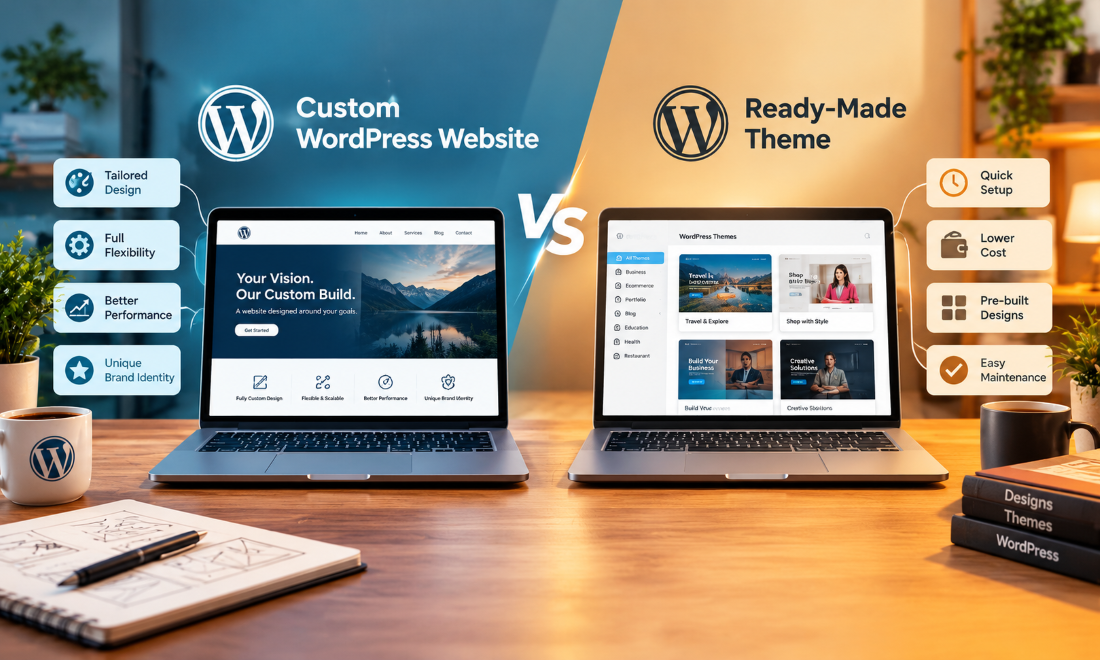
You’ve decided to build a WordPress website. Good choice. WordPress runs a huge share of the web, it’s flexible, and it works for everything from a small business site to a large online store.
Then comes the first real decision. Do you buy a ready-made theme for a few thousand rupees and launch in a week? Or do you invest in a custom-built WordPress website designed around your business?
Both paths are valid, and both can go wrong. The right answer depends on your goals, your budget, and where you want your business to be in two or three years. This guide breaks down the differences in plain language so you can decide with confidence.
What Is a Ready-Made WordPress Theme?
A ready-made theme is a pre-designed template that controls how your website looks and behaves. You install it, add your logo, colours, text, and images, and your site is live. Themes are sold or distributed through marketplaces and the WordPress theme directory, and many come with demo layouts you can import in a few clicks.
Ready-made themes are built to appeal to as many buyers as possible. That’s their strength and their limitation.
What Is a Custom WordPress Website?
A custom WordPress website is designed and developed specifically for your business. A designer plans the layout around your goals, your customers, and your brand. A developer then builds a theme, and often custom functionality, that does exactly what you need and nothing you don’t.
Instead of fitting your business into a template, the website is built to fit your business.
Custom WordPress vs. Ready-Made Theme: Head-to-Head
1. Cost
Ready-made theme: The upfront cost is low. You pay for the theme (some are free), and perhaps a developer to set it up. For a small business or a first website, this is the main attraction.
Custom website: The upfront investment is higher because you’re paying for design, development, and testing. Prices vary widely depending on the number of pages, the features, and the team you hire.
The catch: Cheap upfront doesn’t always mean cheap overall. Themes often need paid plugins, extra developer hours to tweak them, and sometimes a full rebuild when you outgrow them. Custom builds cost more at the start but can save money over time if they won’t need replacing.
2. Speed to Launch
Ready-made theme: Fast. A simple site can go live in days.
Custom website: Slower. A proper custom project involves planning, design, development, content, and testing, so it typically takes weeks.
If you need a site up quickly for an event, a launch, or a test, a theme is hard to beat.
3. Design and Brand Identity
Ready-made theme: Thousands of other websites may use the same theme. Even with customization, your site can look familiar, and you’re limited by the layout options the theme gives you.
Custom website: The design is unique. Every section, spacing, button, and interaction can reflect your brand. For businesses where first impressions matter, such as agencies, real estate, healthcare, luxury, and professional services, this is a big advantage.
4. Website Speed and Performance
This is where many themes struggle. To appeal to every kind of user, popular themes come loaded with features, sliders, animations, scripts, and styling options. Many of these run on your site whether you use them or not, which can slow page loading.
A custom website includes only the code your site needs. That usually means cleaner code, fewer plugins, and faster loading, which matters for both users and Google. Page speed affects user experience, bounce rate, and search visibility.
That said, a well-chosen lightweight theme with sensible plugins can still perform well. Poorly built custom sites can be slow too. Quality matters more than the label.
5. SEO
Both options can rank well, but they give you different levels of control.
Ready-made theme: Good themes follow basic SEO practices, such as clean headings and responsive design. But bloated code, heavy page builders, and limited control over structure can hold you back.
Custom website: You can build SEO into the foundation: clean code, proper heading structure, fast loading, structured data, optimized URL architecture, and mobile-first design. This gives your SEO team much more room to work.
No website is “SEO guaranteed” by default. Content, links, and ongoing optimization still do the heavy lifting. But a strong technical base makes that work easier.
6. Functionality and Flexibility
Ready-made theme: You can add features through plugins. This works well until you need something specific, like a custom booking flow, a calculator, a members area, or a tailored integration. Then you may be stacking multiple plugins that weren’t designed to work together.
Custom website: Features are built to your exact requirements. You can integrate with your CRM, payment gateway, or internal tools in a tidy, purpose-built way.
7. Security
Every WordPress site needs regular updates and good security habits. The difference lies in the amount of third-party code.
Ready-made theme: Popular themes and the many plugins they rely on are attractive targets for attackers. Outdated or abandoned themes and plugins are a common cause of hacked sites.
Custom website: Fewer plugins and leaner code mean a smaller attack surface. You still need updates, backups, and monitoring, but there’s less third-party code that can break or be exploited.
8. Scalability
Ready-made theme: Fine for a small site, but it can become a bottleneck as you grow. Adding new sections, features, or traffic may push the limits of what the theme can handle.
Custom website: Built with your growth in mind. When you add new services, locations, product lines, or integrations, the structure can expand without a rebuild.
9. Support and Maintenance
Ready-made theme: Support comes from the theme author, and quality varies a lot. If the developer stops updating the theme, you’re on your own.
Custom website: You work with the team that built it, who knows the code and can fix issues or add features quickly. You’ll want a maintenance plan, but you’re not dependent on a stranger’s product roadmap.
10. Ownership and Long-Term Control
With a theme, you rely on its license, updates, and the author’s decisions. A custom site is built for you, and you control how it evolves. When you move agencies or developers, a well-documented custom build can be handed over without being tied to a third-party product.
Quick Summary
Ready-made theme: best for
- Startups testing an idea
- Personal blogs and portfolios
- Small businesses with tight budgets
- Simple websites with standard needs
- Quick launches
Custom WordPress website: best for
- Businesses where brand and trust matter
- Websites that need unique features or integrations
- Companies planning to scale
- Sites that depend on search traffic and speed
- Ecommerce, real estate, healthcare, B2B, and service businesses
Is There a Middle Path?
Yes, and it’s more common than people think.
A customized ready-made theme. Start with a quality, lightweight theme and have a developer adapt it with a child theme, custom templates, and a refined design. This costs less than a full custom build while giving you more control than an off-the-shelf install.
A custom theme on a solid framework. Developers sometimes build on a lightweight starter framework, which speeds up development without carrying unnecessary theme features.
This hybrid approach suits businesses that want a polished, branded site without a full custom budget. The key is to choose the base theme carefully, since a bloated theme can’t be fixed by customization alone.
Common Mistakes to Avoid
- Choosing a theme only by its demo. Demos use professionally prepared content and images. Your real site won’t look the same unless you do the same work.
- Installing too many plugins. Every plugin adds code, risk, and potential conflicts.
- Ignoring page speed. Test any theme for speed before committing.
- Paying for “custom” that’s just a template. Ask to see how the design process works and what’s actually being built.
- Skipping maintenance. Updates, backups, and security checks matter for both options.
- Not thinking about the future. A site you’ll have to rebuild in a year isn’t cheap.
How to Decide: Questions to Ask Yourself
- What’s my budget now, and what could it be in a year?
- How important is a unique brand presence?
- Will I need features beyond what a standard theme offers?
- How much does search traffic matter to my business?
- How fast do I need to launch?
- Do I plan to grow, expand, or add services soon?
- Who will maintain the site after launch?
If most of your answers point toward speed, simplicity, and low cost, a ready-made theme is a reasonable choice. If they point toward brand, performance, growth, and control, invest in custom development.
What to Look for in a WordPress Development Partner
If you decide on a custom or customized build, the team you hire matters as much as the approach. Look for:
- A portfolio of real, live WordPress websites
- A clear process covering discovery, design, development, testing, and launch
- Attention to speed, SEO, and mobile responsiveness from day one
- Transparent communication and realistic timelines
- Post-launch support and maintenance options
- Code that’s clean and documented, so you aren’t locked in
At Inbounderz, our team builds WordPress websites that are designed around business goals, optimized for speed and search, and ready to grow with you. If you’re weighing your options, explore our WordPress development services or get in touch for a free consultation, and we’ll help you work out which approach fits your project.
Frequently Asked Questions
A ready-made theme is a pre-built design you customize with your content and branding. A custom WordPress website is designed and developed specifically for your business, with a unique layout and features built around your needs.
Not always. A custom website is usually better for brand-focused, growth-oriented, and feature-heavy projects. A ready-made theme can be a smart choice for small budgets, simple sites, and quick launches.
Yes, the upfront cost is higher because you’re paying for design and development. However, themes can add hidden costs through paid plugins, extra tweaks, and eventual rebuilds, so the long-term gap may be smaller than it looks.
They often do, because they include only the code you need. Ready-made themes can carry extra scripts and features that slow pages down. Still, a lightweight, well-built theme can perform well, so quality matters more than category.
It gives you more control over structure, speed, and technical elements, which helps. But SEO depends mostly on content, links, and ongoing work, so no website type guarantees rankings.
It depends on the size and complexity, but a typical business website takes several weeks from planning to launch. Larger sites with custom features take longer. A ready-made theme can often be set up in days.
Yes. Many businesses start with a theme and move to a custom design as they grow. Plan for it by keeping your content organized and choosing a reputable platform, so migration is smoother.
Reputable, regularly updated themes can be secure. Risks come from outdated, abandoned, or poorly coded themes and plugins. Keep everything updated, use trusted sources, and maintain regular backups.
Many online stores need custom functionality, strong performance, and a smooth checkout experience, which often points to a custom or heavily customized build. Small stores with simple catalogues can start with a quality ecommerce theme.
Final Thoughts
There’s no single winner in the custom WordPress vs. ready-made theme debate. A theme gets you online quickly and affordably. A custom website gives you a distinctive brand, stronger performance, and room to grow.
Think about what your website needs to do for your business, not just what it needs to look like on launch day. If it’s a simple first step, start with a theme. If it’s the foundation of how customers find, judge, and trust you, building it properly from the start is usually the smarter investment.