Introduction
In the last few years, AI has fundamentally reshaped the way marketing functions. From content creation to customer engagement, nearly every aspect of digital marketing has evolved, and search engine visibility is no exception. The rise of AI-powered search experiences, including Google AI Overviews and generative search assistants, is changing how users discover and consume information online.
This shift has given rise to Generative Engine Optimisation (GEO), a new approach that expands the role of traditional SEO in an AI-driven search landscape. While SEO remains as important as ever, strategies that fail to adapt to AI-powered search behaviour risk losing relevance. Ranking today is no longer just about keywords and backlinks; it’s about creating content that AI systems can understand, trust, and surface effectively.
The impact of this transformation is already visible across search engines and AI platforms, signalling a need for businesses to rethink their content strategy. In this blog, we’ll explore how content needs to be re-strategized to rank on Google and AI Search in 2026.
How AI Search is Changing SEO in 2026
Source: WebFX
Many businesses have reported declining website traffic with the rise of AI-powered search, hinting a major shift in how content is discovered and consumed. Users today increasingly rely on AI-generated summaries, conversational search, and answer-based experiences instead of browsing through multiple webpages for information.
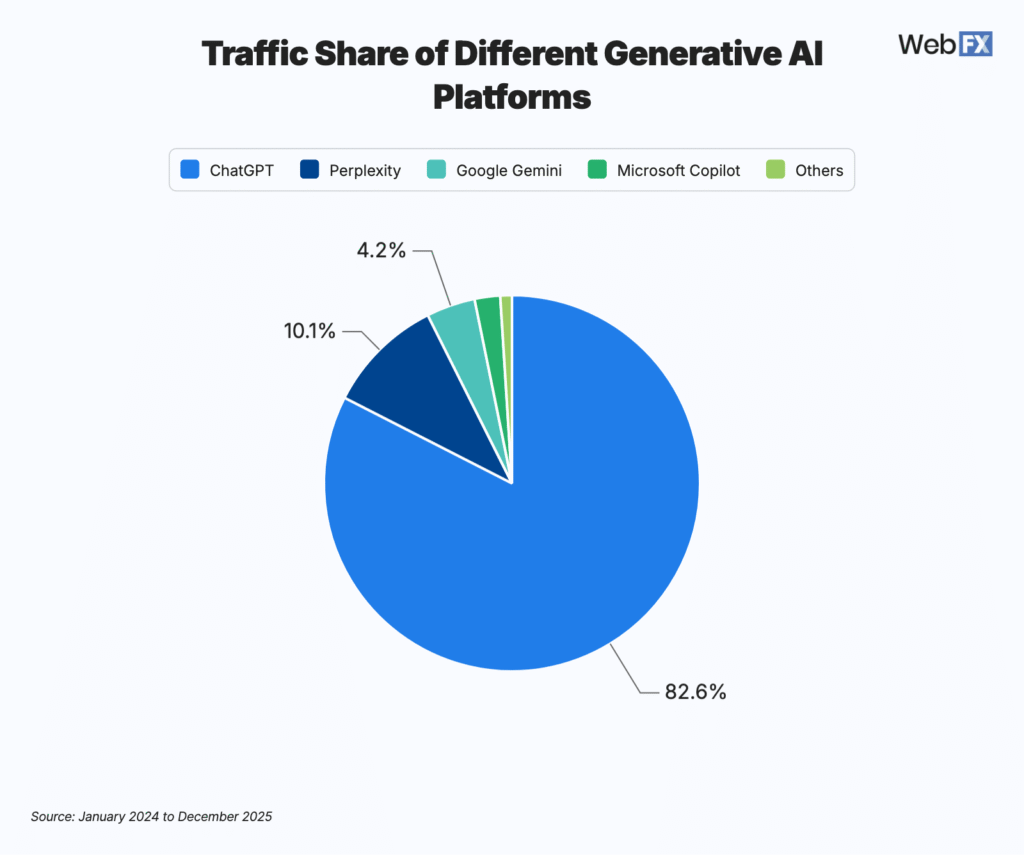
This shift is also reflected in the growing dominance of generative AI platforms. Among AI-driven traffic sources, ChatGPT alone accounts for nearly 82.6% of the traffic share, followed by Perplexity at 10.1% and Google Gemini at 4.2%. These numbers highlight how platforms powered by generative AI are rapidly becoming key gateways for content discovery and user engagement.
The objective now is to ensure your content gets picked up and referenced within AI-generated answers. AI summaries work by scanning multiple sources, identifying the most relevant and trustworthy information, and compiling it into a concise response for the user. When your content is cited within these summaries, it is capable of driving valuable traffic to your website.
In simple terms, search success is no longer just about ranking higher on Google; it’s about becoming a trusted source that AI-powered search platforms choose to surface in their answers.
| Factors | GEO | SEO |
| Content | Natural language, contextually relevant | Keywords and metadata optimised |
| Keywords | Supports a content-rich piece | Strategically placed in the content |
| Platforms | ChatGPT, Google AI Summary, Perplexity, Gemini, etc. | SERPs like Google, Bing, etc. |
| Success Metrics | Mentions and citations | Clicks, Impressions, CTR, etc. |
Understand Search Intent Before Creating Content
Search intent has always been important in SEO, and that remains true even in the age of AI-SEO. However, traditional SEO focused heavily on matching intent with exact-match keywords and metadata. Today, AI-powered search engines go beyond keywords to understand the actual meaning, context, and purpose behind a user’s query.
There are four main types of search intent:
- Informational Intent – Users want answers or knowledge.
- Commercial Intent – Users are researching before making a purchase decision.
- Transactional Intent – Users are ready to take action or buy.
- Navigational Intent – Users are searching for a specific brand or website.
Search intent SEO is now more important than keyword stuffing because Google and AI search tools analyse user behaviour and conversational context to determine which content best satisfies a query.
A strong content strategy for SEO should match intent. Also note that searches work better with guides, blogs, and FAQs, while transactional searches need strong landing pages and clear CTAs.
How to Create Content That Ranks on Google and AI Search
While some principles have changed, the fundamental foundation of creating content that’s the best online (on that particular topic) remains unchanged. Google AI summary and platforms like ChatGPT and Gemini pick content that’s clear and answers the question at first glance. It’s worth noting that many times, the answers that are featured on the AI snippet usually rank in the 11th- 20th position on SERP, so even if you’re not ranking on the first page of the SERP, but have quality content, AI search engines will pick it up.
There are a myriad of healthy practises you can follow that will help you rank on AI answer summaries. Here are a few:
- In the first 2 or 3 paragraphs, try to answer the question. It should be direct, concise, and clear.
- Avoid using jargon. Always use natural and conversational language.
- If you’re writing pillar content, ensure it’s broken into scannable paragraphs with clear and relevant subheadings.
- Steadily build topical authority SEO for your website by covering topics from various content buckets relevant to your business
- Content that references statistics and has well-researched content
- Use Experience, Expertise, Authority, and Trust (EEAT) principles. Use credible information, positive reviews, link to internal and external sites, etc. EEAT SEO helps build credibility and trustworthiness.
Following this checklist for each one of your website pages will help you have a healthy AI-SEO score and eventually start ranking on Google AI Summaries.
When it comes to technical SEO, the fundamentals remain the same. Your pages should be mobile-friendly, load within 2-3 seconds, and optimise images for size and include alt text. In addition, implementing the appropriate schema markup across all pages is essential.
Conclusion
In conclusion, the SEO landscape has evolved rapidly, and it continues to shift with the rise of AI-driven search. To align with GEO and AEO standards, your content needs to be helpful, authoritative, and deeply aligned with user intent. While search algorithms continue to evolve, the core fundamentals remain unchanged: strong technical SEO and high-quality content still matter the most.
For your content to rank and get picked up by AI-powered search engines, it needs to be among the most valuable and relevant resources available on that topic online.
Not sure where to begin with GEO? At Inbounderz, we ensure every webpage and piece of content meets the latest SEO, AEO, and GEO standards, helping your brand stay visible in the evolving search landscape.
Frequently Asked Questions (FAQs)
- What is AI SEO?
AI SEO refers to optimising content for AI-powered search and answer engines that generate direct responses for users. It focuses on creating content that is clear, trustworthy, intent-driven, and easy for AI systems to understand and reference.
- How does AI search affect Google rankings?
AI search changes how users interact with search results by prioritising direct answers and summaries over traditional blue links. This means businesses must focus not only on rankings, but also on creating authoritative content that AI systems are likely to cite and surface.
- Can AI-generated content rank on Google?
Yes, AI-generated content can rank on Google if it is original, accurate, valuable, and aligned with user intent. Google prioritises helpful, high-quality content regardless of whether it is created by humans or assisted by AI.
- What is topical authority in SEO?
Topical authority refers to how credible and knowledgeable your website appears on a specific subject. It is built by consistently publishing high-quality, in-depth content around related topics, helping search engines and AI platforms recognise your site as a trusted source.