Search behavior is changing faster than most marketers can keep up with. People no longer type a keyword into Google and scroll through ten blue links. They open ChatGPT, ask a full question, and expect a direct, useful answer. And now, that answer can come with an ad attached to it.
In January 2026, OpenAI confirmed it would start testing ads inside ChatGPT for logged-in users on the Free tier and the lower-cost Go plan. This single move opened up a brand-new advertising channel, one that sits right at the moment a user is asking for help, comparing options, or ready to buy.
For businesses, that is a big deal. It means showing up not just when someone searches, but when someone is actively deciding.
This blog breaks down what ChatGPT ads actually are, how they work, why they matter for high-intent users, and how businesses can build a ChatGPT ads strategy that fits into the wider AI search era, without wasting budget on guesswork.
What Are ChatGPT Ads and Why Are They Happening Now?
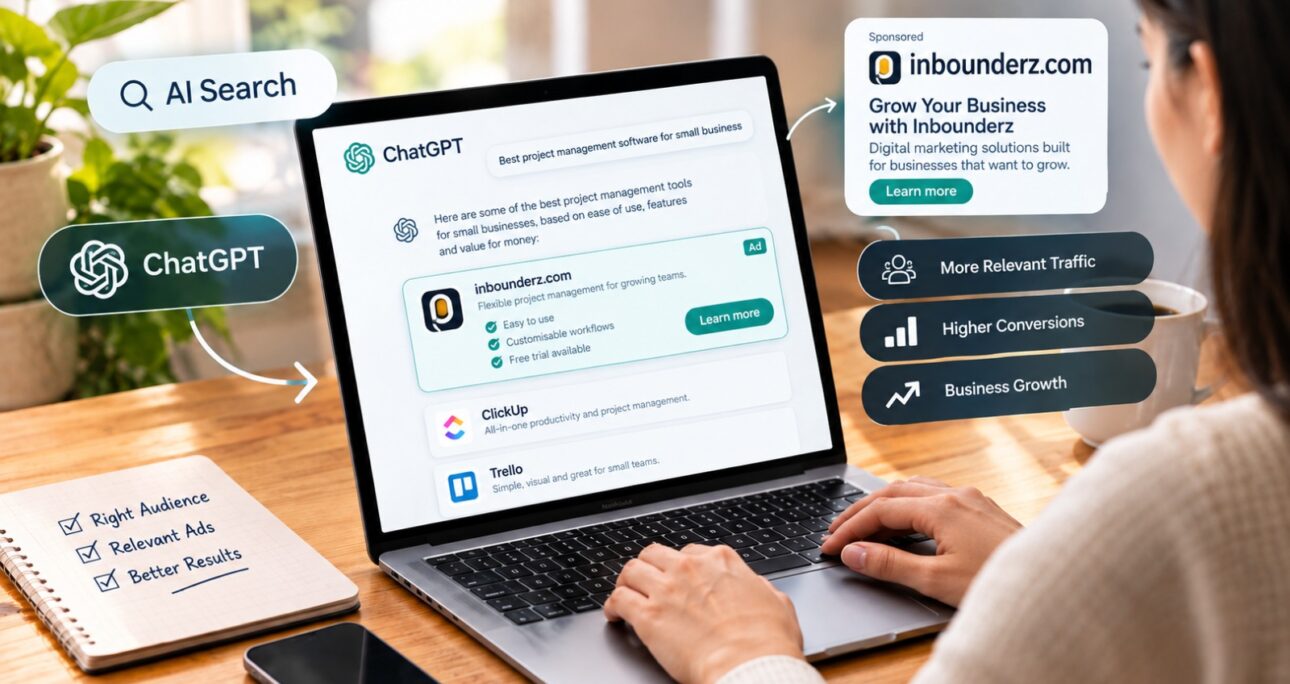
ChatGPT ads are sponsored placements that appear below or alongside a ChatGPT response. They are clearly labeled as “Sponsored” and kept visually separate from the assistant’s actual answer. OpenAI has stated that ads do not influence the content of the response itself, and that user conversations are not sold to advertisers.
So why is this happening now? Simply put, running an AI model at this scale costs an enormous amount of money. ChatGPT has hundreds of millions of weekly active users, but only a small fraction pay for a subscription. Advertising gives OpenAI a way to keep the free version accessible while funding the infrastructure needed to keep improving the product. It is the same model streaming platforms and search engines have used for years, just applied to a conversational AI interface.
For businesses, the timing matters just as much as the format. ChatGPT is increasingly being used the way people once used Google, to research products, compare brands, and ask “what should I buy.” That shift is exactly why marketers are calling this the AI search era.
How Do ChatGPT Ads Actually Work?
Understanding the mechanics helps businesses plan a smarter approach, so here is a simple breakdown of how ChatGPT advertising currently functions.
Placement: Ads appear after a ChatGPT response, in a separate block, not blended into the answer itself.
Eligibility: Ads currently show to users on the Free and Go tiers. Paid plans such as Plus, Pro, Business, and Enterprise remain ad-free.
Relevance-based triggering: Ads are shown only when they match the intent of the user’s query, not on every conversation.
Query type matters: Commercial-intent questions, like product comparisons or purchase-related queries, are far more likely to trigger an ad than purely informational questions.
Sponsored labeling: Every ad carries a clear “Sponsored” tag so users can tell the difference between an organic answer and a paid placement.
This structure tells businesses something important. ChatGPT ads are not built for mass-reach brand awareness the way a display banner is. They are built around intent, which makes them a strong fit for businesses chasing quality leads over sheer traffic volume.
Why High-Intent Users Matter More Than Ever in AI Search
A high-intent user is someone who has already moved past casual browsing and is close to making a decision. Think of someone asking ChatGPT, “which CRM software is best for a 20-person sales team” or “compare running shoes for flat feet under 8000 rupees.” That is not a casual question. That is a buying signal.
Traditional search still works, but users increasingly turn to AI tools for research because it saves time. Instead of opening ten tabs, they get a synthesized answer in one go. This means the businesses that show up inside that answer, or as a sponsored option right next to it, get a shot at the customer at the exact moment they are ready to act.
This is also why ChatGPT ads strategy cannot be treated like a copy-paste version of Google Ads or Meta Ads. The intent signal is stronger, the context is conversational, and the audience expects relevance, not a generic sales pitch.
How Businesses Can Build a Smart ChatGPT Ads Strategy
Start With Commercial-Intent Keywords, Not Broad Topics
Since ads mostly trigger on commercial-intent queries, businesses should map out the specific questions their customers ask right before buying. Think “best,” “vs,” “near me,” “under budget,” and “for [specific use case]” style phrasing. These queries carry buying intent and are far more likely to place an ad in front of the right person.
Write Ad Copy That Sounds Like a Helpful Answer, Not a Billboard
ChatGPT users are in a conversational mindset. Ad copy that reads like a traditional banner ad will feel out of place. Businesses should write clear, direct, benefit-led copy that answers the implied question honestly. Skip the hype. State what the product does, who it is for, and why it is worth a click.
Optimize for Answer Engines, Not Just Search Engines
This is where Answer Engine Optimization, or AEO, comes in. AEO is the practice of structuring content so AI tools can easily understand it, summarize it, and cite it as a trustworthy source. A strong AEO approach includes:
- Clear, direct answers near the top of a page or article
- Structured headings that mirror real questions people ask
- Simple language instead of jargon-heavy copy
- Accurate, up-to-date facts an AI model can pull from confidently
- Schema markup that helps machines read the page correctly
When a brand’s website and content are already Answer Engine friendly, or also called AEO-friendly, its ChatGPT ads work harder because the brand is more likely to be recognized as a credible, relevant answer in the first place.
Combine Paid Placements With Organic AI Visibility
Businesses should not rely on ChatGPT ads alone. Getting mentioned organically inside ChatGPT answers, through strong content, reviews, and digital PR, builds trust that paid ads alone cannot buy. A business that appears both organically and as a sponsored option sends a stronger signal of credibility to the user.
Track the Right Metrics From Day One
Since this is a new channel, businesses should set clear benchmarks early. Watch click-through rate, cost per click, and most importantly, what happens after the click. Does the traffic convert? Are the leads actually qualified? Early data will look different from mature channels like Google Ads, so patience and consistent tracking matter here.
Keep a Human Team in the Loop
AI tools can speed up keyword research, ad copy drafts, and performance analysis, but a human strategist still needs to review targeting, tone, and brand fit. ChatGPT users are quick to notice content that feels robotic or off-brand, and that hurts trust fast.
Common Mistakes Businesses Should Avoid
Treating ChatGPT ads like a copy of Google Ads: The intent, tone, and placement are different, so the strategy needs to be different too.
Ignoring informational queries entirely: While ads trigger less often here, showing up organically in these answers still builds long-term brand trust.
Skipping AEO groundwork: A business with no answer-friendly content on its site will struggle to build the credibility that makes paid ads convert.
Overlooking measurement: Businesses that do not track post-click behavior will not know if the channel is actually working for them.
Using generic, sales-heavy ad copy: Conversational platforms reward clarity and honesty over hard-sell language.
What This Means for the Future of Digital Marketing
ChatGPT ads are still in an early phase, and the format will keep evolving. But the direction is clear. AI search is becoming a real discovery channel, sitting right alongside Google and social media. Businesses that wait too long to understand this shift risk losing visibility to competitors who move early.
The businesses that win in this new landscape will be the ones who treat AI search as its own discipline, not an afterthought bolted onto an existing SEO or PPC plan. That means building content that AI tools trust, running ads that respect the conversational format, and measuring results honestly as the channel matures.
Ready to Get Ahead in the AI Search Era?
AI search is moving fast, and businesses that plan their strategy early will have a real advantage over those who wait and see.
If you want to explore how a ChatGPT ads strategy, combined with strong AEO and SEO, can help your business reach high-intent users at the right moment, the team at Inbounderz can help you build a plan that actually fits your goals. Get in touch with Inbounderz for a customized strategy session and see where your brand stands in AI search today.
Frequently Asked Questions
A ChatGPT ad is a sponsored placement that appears below or next to a ChatGPT response. It is clearly marked as “Sponsored” and stays separate from the assistant’s actual answer, so users always know the difference between organic and paid content.
Ads currently appear for logged-in users on the Free tier and the lower-cost Go plan. Users on Plus, Pro, Business, and Enterprise plans do not see ads, since those tiers are paid subscriptions.
No. Google Ads works around keyword bidding on a search results page, while ChatGPT ads appear inside a conversational answer, triggered mainly by commercial-intent queries. The format, tone, and user expectations are different, so a ChatGPT ads strategy needs its own approach rather than a copy of an existing PPC playbook.
A business should start by identifying the commercial-intent questions its customers ask, building AEO-friendly content that AI tools can understand and cite, and setting up clear tracking so it can measure real performance once ad placements go live in its market.
Yes. Answer Engine Optimization improves how often a brand gets mentioned organically inside AI-generated answers, on ChatGPT and other AI search tools alike. This builds visibility and trust well before a business decides to invest in paid AI placements.